Skincare & Wellbeing
One Humiliating Zoom Moment Showed Me How Much My Skin Had Sagged. Eight Months Later and My Colleagues Think I've Spent Thousands on a Procedure.

The call that changed everything — November 2024
The meeting had been running for twenty minutes before I accidentally hit the wrong button.
Quarterly headcount review. Twelve faces in the gallery, the usual half-listening energy, someone's cat visible in the bottom left corner. I'd done this call a hundred times. I was mid-sentence, sharing a slide, reaching to switch the screen view — and I clicked the wrong icon.
The gallery went full screen across my monitor.
Twelve small faces arranged in neat tiles. And one large one in the centre.
Mine.
I'd seen myself on camera before, obviously. But always glancing, always moving, always the small thumbnail in the corner that you register and immediately stop registering. This was different. This was frozen. Caught mid-sentence, mouth slightly open, the overhead light from my home office doing absolutely nothing for me.
I stared at it for three seconds before I found the button to go back.
Three seconds was enough.
The lines around my mouth — deeper than I'd let myself register in any mirror. The skin along my jaw, soft in a way it hadn't been, the definition I'd had through my early forties just quietly gone. The hollows under my eyes sitting in shadow. And my skin tone: not ill exactly, not dramatic, but flat. Dull. A grey, tired quality that no amount of sleep seemed to shift anymore.
The face on the screen didn't look like someone who runs a department of forty people. It looked like someone who had stopped fighting something. Who had quietly, gradually, given up on something she couldn't quite name.
I clicked camera off. "Sorry — connection's playing up," I said, and carried on presenting. My voice came out completely steady.
Nobody noticed. That was almost the worst part.
What I Saw When I Finally Looked Properly
That evening I stood in front of the bathroom mirror and actually looked. Not the quick glance while brushing teeth. Not the half-second check before a meeting. I turned the light on properly, stood close, and stayed there.

That evening. Proper light. Actually looking.
The camera hadn't lied. If anything it had been kind.
The fine lines around my eyes had deepened since — I tried to remember — since when, exactly? The lines around my mouth were no longer fine. The skin along my cheekbones had lost its hold. I pressed two fingers gently against my cheek and let go. The skin moved back slowly. It used to spring back. Now it settled. Like it had forgotten what it was supposed to do.
The jaw I'd always had — clean, defined, something I'd never once thought about because it had simply always been there — had softened. Not suddenly. Gradually. The way these things go: completely imperceptibly until one bad Teams call makes it impossible to ignore.
I was 48. I felt nothing like 48. Inside, I was exactly who I'd always been. Sharp. Decisive. The person who reads a room in thirty seconds. Outside — outside was its own conversation now, and it had been happening without me for longer than I wanted to admit.
I turned the bathroom light off. Then turned it back on. Then off again.
I told myself it was fine. I was nearly fifty. This is what nearly fifty looks like.
I went to bed and lay there thinking about nothing specific, which meant I was thinking about exactly that.
What I Found Out at 1am That Changed Everything
A few weeks later, instead of sleeping, I did what every woman my age does when something is quietly eating at her. I Googled it.
"Why is skin sagging after 40." "Wrinkles getting deeper every year." "Why does my face look so tired."

1:14am. Down the rabbit hole.
I was down the rabbit hole until well past one in the morning. And I came out the other side genuinely angry that nobody had explained any of this to me before.
Here is what I found.
Your skin's structure depends on collagen — the protein that gives it firmness, definition, bounce. After the age of 30, your body produces roughly 1% less of it every year. By the time I was sitting there at 1am, I'd lost close to 20% of the collagen I'd had at 30. That's the scaffolding underneath. The thing that holds everything up.
But here's the part that made me put my phone down for a minute.
It's not just that production slows. Enzymes called MMP-1 and MMP-3 actively break existing collagen down — and they accelerate with age. My skin wasn't just failing to build new scaffolding. It was dismantling what was left. The sagging jaw, the deepening wrinkles, the skin that settled instead of springing — it wasn't five separate problems. It was one compounding structural failure that had been happening quietly for fifteen years while I was running teams and raising children and not looking in mirrors properly.
The dullness, the grey flat tone, the wrinkles getting deeper every winter: same root cause. Same system. All connected.
I sat there at half past one in the morning and thought: this isn't vanity. This is cellular. And I'd been throwing money at symptoms while the actual problem kept building underneath.
Everything I Tried (And Why None of It Worked)
She becomes methodical about it. She's an HR director. She makes decisions based on evidence. She researches, she commits, she follows through. This is what following through looked like over fourteen months.

Nearly £900. Fourteen months. Nothing to show for it.
Botox
I'd said for years I'd never do it. Then I booked it.
A reputable clinic, not a beauty salon — I checked the practitioner's credentials three times. The forehead lines smoothed out nicely. I won't pretend otherwise. But the sagging along my jaw, the loss of definition, the skin that had moved south over years — Botox doesn't lift what gravity and collagen loss have taken. The injector told me, gently, that I'd need filler for that. Different procedure. Different price. I thanked him and didn't book it.
A £110 Peptide Serum
From a brand that sells exclusively through three department stores and has a six-month waiting list for certain products. The packaging was extraordinary — the kind that makes you feel like you've made a serious decision just by owning it.
I looked the ingredient list up properly about two months in. The bakuchiol was present at 0.3%. A dermatology forum I found described the peptide complex as "present at concentrations too low to produce measurable results." I used it for four months because I'd spent £110 and I wasn't giving up at week six. By month four I was tilting my face toward the bathroom mirror at specific angles to catch the light that made it look like something had changed.
Nothing had changed.
NAD+ Supplements
I'd read about them in three separate places — a longevity piece in The Times, a podcast a friend had sent me, a thread on a private women's health forum. The science sounded genuinely serious. Cellular energy, mitochondrial repair, age reversal at a biological level. I took them for five months. My energy was probably better — I actually think that part was real. My skin looked exactly the same.

Six sessions at £85 each. The results lasted three weeks.
Microcurrent Facials
Six sessions at £85 each. The aesthetician showed me before-and-after photographs of other clients that looked remarkable. After session three I thought I could see a difference. After session six I couldn't find it anymore. When I stopped going, whatever small improvement had been there — if it had been real — disappeared within three weeks.
By the time I'd spent the better part of £900 across fourteen months, I had developed a specific expression I made in mirrors: a quick look, a small flat smile, a pivot. I'd learned to do my makeup in under two minutes without really seeing myself. I'd learned the camera angles that worked and the ones that didn't.
It wasn't denial. It was efficiency. You stop trying when trying consistently fails. You start saying "I'm nearly fifty" to yourself like that's an explanation, and not just a surrender dressed up as acceptance.
The WhatsApp Photo I Couldn't Stop Looking At
A friend's birthday dinner in March. Someone posted the group photo in the WhatsApp chat that evening — four of us, wine glasses, warm restaurant lighting. The kind of photo where everyone looks slightly better than real life.
I looked at it and felt the familiar clench.

I looked at it longer than I want to admit.
I was the one who looked the most tired. The most aged. The most like time had been doing something to my face that it hadn't been doing to anyone else's. I nearly scrolled past it. Then I noticed Jess.
Jess is 49. We've been friends since university — she lives in Bath now, runs her own HR consultancy, has very strong opinions about Botox (against, loudly, at dinner parties). I know her face as well as I know my own. And in this photo, her face looked — I searched for the right word — lifted. Clear. Defined along the jaw in a way mine wasn't anymore. That quality of someone whose outside matches their inside.
Jess doesn't do procedures. So it wasn't that.
I called her that weekend instead of texting.
What Jess Told Me
She'd had the same thing eighteen months ago. Not dark spots — the other thing. The greyness. The loss of definition. The wrinkles deepening through winter and not quite recovering in summer. The face that had stopped matching how she felt.
She'd tried the same category of things I had. Then a colleague of hers — works in pharmaceutical research at a company outside Cambridge — had mentioned a small European brand. Said the formulation was unusual. Clinical concentrations on the active ingredients rather than decorative ones. Jess had looked into it properly before ordering, because Jess looks into everything properly.
Eight months of daily use.
She sent me a before photo. Same angle, same lighting, taken the day she started. Then the photo from three months ago.
I looked at them for a long time. Then I looked at the birthday dinner photo again.
"What did it cost?" I asked.
A pause on the line. Then: "That's the part you're not going to believe."
What's Actually In It (And Why I Stopped Being Sceptical)
I researched it the way I research everything — properly, until I understood it. I was half-hoping to find a reason to dismiss it. One questionable claim, one inflated concentration, one ingredient that didn't hold up. Then I could close the browser and go back to being resigned.
I couldn't find it. The more I looked, the more I realised this wasn't a nice bottle with a story attached. It was a formula built around three actives at concentrations I hadn't seen in anything I'd tried before.

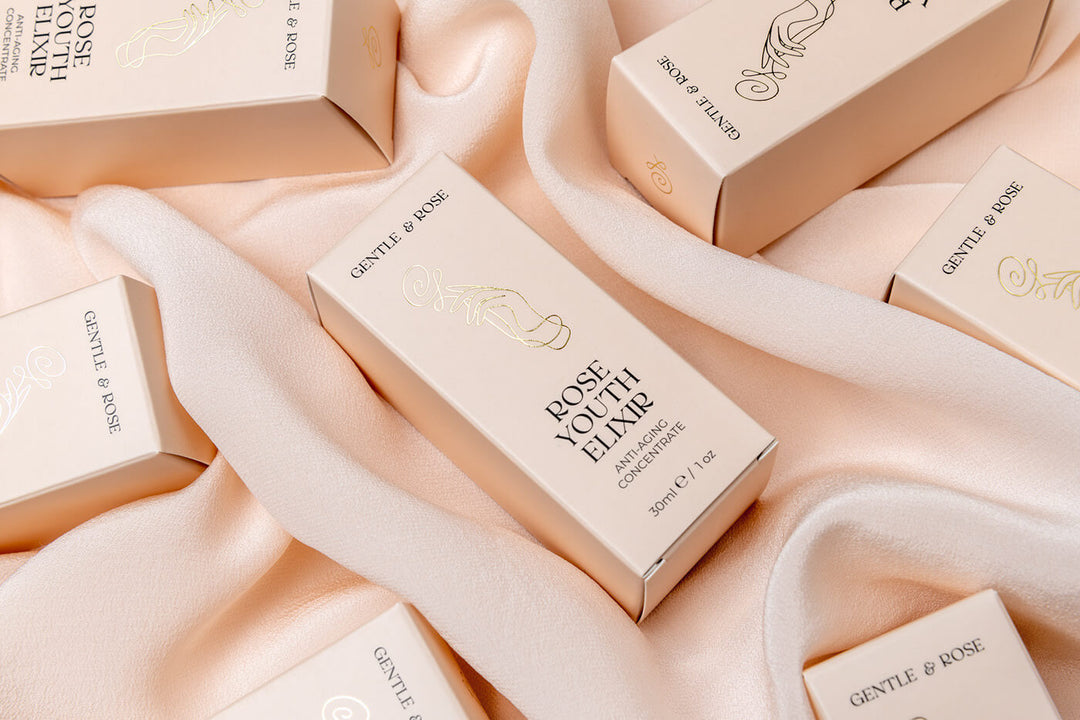
Rose Youth Elixir by Gentle & Rose. The "it arrived" photo.
Bakuchiol at 2% — The Collagen Rebuilder
A plant compound that works through the same biological pathway as retinol — directly stimulating collagen production, inhibiting MMP-1 and MMP-3 (the exact enzymes breaking my scaffolding down), accelerating cell turnover. Without the peeling, without the sun sensitivity, without four days working from home telling your team you have a cold.

The British Journal of Dermatology trial. I read it twice.
The clinical dose used in the British Journal of Dermatology trial — the one that showed measurable results — was 2%. The £110 peptide serum I'd used for four months: 0.3%. The difference between 0.3% and 2% is the difference between a marketing claim and a clinical result.
Bulgarian Damascena Rose Oil — The Barrier Repairer
Cold-pressed, from the Kazanlak Valley in Bulgaria — the same grade that Chanel and Dior source at €6,000 per litre to use in trace concentrations in their perfumes. This formula uses it at therapeutic concentration. For the grey, dull, flat tone I'd been fighting — the one that no amount of sleep seemed to shift — this is what addresses it at the source. Deep barrier repair. The kind of moisture retention that British winters and central heating spend all year stripping away.
Low-Molecular-Weight Hyaluronic Acid — The Structural Hydrator
Not the surface kind that sits on top of your skin and evaporates within the hour. The molecule small enough to penetrate to the dermal layer. Twelve to sixteen hours of hydration that holds. The plumpness that makes skin look lifted isn't surgery. It's deep structural hydration. This is where it comes from.
I'd spent fourteen months and nearly £900 on products that each addressed one piece of the problem. This addressed all of it. Every morning. One step.
Ships to UK · All duties included · 30-day returns
The Family That Makes It
I went looking for who was behind it.
Gentle & Rose is a family from the Kazanlak Valley in Bulgaria — the region that produces 85% of the world's damascena rose oil. Not rose water. Not synthetic rose fragrance. The real thing — the same cold-pressed oil that the great French fragrance houses have been buying from this valley for a century. The family has been connected to the rose trade for three generations.

The Kazanlak Valley. 85% of the world's damascena rose oil comes from here.
They watched the tanker trucks arrive every May during harvest, buying oil in bulk at €6,000 to €8,000 per litre to ship to France. Where luxury brands would dilute it to trace concentrations, put it in beautiful boxes, hire a celebrity, and sell it back to European women at a hundred times the cost. The woman buying the £200 serum thinks she's buying Bulgarian rose oil. She's buying a memory of it.
At some point the family's mother said: what if we stopped watching?
No celebrity ambassador. No department store contract. No distributor taking 40% of the margin. Small batches, formulated in their workshop. Every batch manufactured under EU Cosmetics Regulation EC 1223/2009 — the same regulatory framework that governs Dior and La Mer. Same standards. Completely different priorities.
I also found out — and this is the kind of detail that makes me trust a company — that every order funds the planting of at least three trees. Their packaging is sustainable. They don't test on animals. None of this is plastered across the bottle in large letters trying to make you feel obligated. I had to go looking for it. Which made me trust it more, honestly.
Ships to UK · All duties included · 30-day returns
The Price That Made Me Check Twice
I went to the UK site expecting £120. Given the bakuchiol concentration, given the damascena rose oil grade, given the hyaluronic acid profile — £150 would have made sense. I had mentally prepared myself for £150 and decided I would pay it.
I scrolled to the product page.

I checked it twice. Then emailed them to ask if it was right.
Less than a blow-dry. Less than the firming cream that did nothing. Less than one microcurrent session.
I checked twice. I went back to the ingredient list and checked again. I emailed the company that night and asked them directly: how is this possible?
The answer was the simplest sentence I'd read in months.
Less than the firming cream I'd used morning and night for three months and couldn't tell was doing anything. Less than one single microcurrent facial. A fraction of the £110 serum that had done precisely nothing at 0.3% concentration. Less than a blow-dry. Less than a decent lunch in the city.
I ordered two bottles that night, sitting on the sofa, with Jess still on the phone.
"I told you," she said. I could hear her smiling.
Ships to UK · All duties included · 30-day returns
What Actually Happened When I Used It

Week one. I started documenting because I didn't trust myself to notice gradual change.
The texture. It absorbs in seconds — no residue, no film, no product smell that lingers. I kept touching my face during the morning because my skin felt like skin rather than something coated in something else. This sounds like a minor thing. It isn't. It's the reason I used it every single evening without once resenting it.
The dullness started to lift. That flat, grey, exhausted tone I'd been fighting — not with a dramatic shift, but with a quality of colour returning underneath. Not flush. Just life. I stopped using my separate moisturiser because I didn't need it anymore.
I caught myself in the bathroom mirror in good light and stopped. The jawline. It wasn't dramatic. But the softness that had settled there over the past few years — it was pulling back. Slightly. Undeniably. I took a photo and compared it to one from six weeks earlier and the difference was there. Not wishful thinking. There.
A colleague — someone I manage, not a close friend, someone with no social incentive to say it unless it were true — stopped me in the corridor one morning. "Katherine, you look incredible. Have you been somewhere?" I said I'd been sleeping better. I hadn't been sleeping any differently at all.

Three months later. Same bathroom, same light, same angle. I sent this one to Jess.
Two people asked if I'd had a procedure done. One was my sister, who has known my face her entire life and notices everything. The other was a woman I know from school. I haven't had a procedure. I've been putting one serum on my face every evening for eight months. That's everything. That's all of it.
The lines around my eyes haven't disappeared. I'm 48, not 28, and I am not claiming otherwise. But they've lost their depth. The jaw has its definition back. My skin has that quality of looking like it belongs to someone who is doing well. Someone whose outside matches her inside.
The last Teams call I was on, I turned my camera on before anyone else joined. I didn't even think about it. I just did it.
Ships to UK · All duties included · 30-day returns
What Other Women Are Saying
Over 80,000 women have tried Rose Youth Elixir. Since I started mentioning it — and I have become one of those people who mentions it unprompted, I'm aware — I've come across stories that sound remarkably like mine.

I'm 57 and had been losing definition along my jaw for about three years — that soft, slightly jowly look I kept trying to disguise with contouring. My daughter bought me two bottles and I think she was genuinely tired of hearing me complain. After about eight weeks I stopped reaching for the contouring brush in the mornings. After four months, a woman at work asked if I'd had something done. I hadn't. I've now been using it for six months and I won't stop.
Margaret, 57 — Leeds
I work in clinical research so I read ingredient lists properly. The bakuchiol concentration in this is the only one I've found that matches the dose used in published trials. I started using it for the fine lines around my eyes and the loss of firmness along my jaw. At month three, the change was significant enough that I photographed it to document it. My husband — who notices nothing — noticed.
Dr. Nadia Chen, 51 — Oxford
I was completely sceptical. I'd already been through the expensive serums, one round of Botox, and about four lifting creams that did nothing. A friend recommended this and I nearly didn't bother. Eight months in, I look better than I have since my late thirties. I'm not exaggerating. My sister asked what I'd done and when I told her it was a £34 serum she didn't believe me. I showed her the order confirmation.
Rachel, 44 — Bristol
Ships to UK · All duties included · 30-day returns
A Few Honest Things Before You Decide
I want to be straight with you, because I spent nearly £900 on products that promised real change and delivered nothing measurable.
This is not instant. Collagen rebuilding is slow, real biology — the same biology that let the scaffolding collapse gradually over fifteen years. The hydration and texture changes happen within the first week. I'll give it that immediately. But the visible lifting, the reduction in wrinkle depth, the jaw definition returning — that is a six to twelve week process with daily use. Anyone who tells you otherwise is lying to you.
Commit to at least two bottles. One bottle shows you it works. Two bottles shows you what your skin can actually look like when it's given something at the right concentration for long enough.
Gentle & Rose offer a 30-day returns policy if it isn't right for you. They ship to the UK from Europe — 5 to 9 business days, all duties and VAT included in the price you see.
One thing I'll mention because it caught me out the second time I ordered: they produce in small batches and they genuinely sell out. Not in a manufactured "only 3 left" way. Actually out of stock. First time I ordered it arrived in four days. Second time I waited nine days for a restock. If it's showing as available when you look, I wouldn't sit on it.
If You Recognised Yourself Anywhere in This
I think about what would have happened if I'd left it after that Teams call. If I'd kept the camera off and kept buying concealer in a slightly darker shade to draw my jawline back in. If I'd kept saying "I'm nearly fifty" like that was a reason instead of a retreat.
I think about the women who find this page, read this far, and close the tab because they've been disappointed before. I know exactly where they are. Same wrinkles. Same sagging. Same quiet resignation that this is just what this decade looks like and you'd better accept it.
I was there. I understand why you close the tab.
But I also know that if Jess hadn't picked up the phone that Sunday, if I hadn't looked into it properly, if I hadn't ordered it despite being almost certain it would be another disappointment — I'd still be there. Same face in the mirror. Same clench when someone posts a group photo. Same camera off.
The face I saw frozen on that Teams call — grey, sagging, not matching who I am inside — was real. But it wasn't permanent. It was fixable. I just needed the right thing at the right concentration for long enough.
Eight months later, I look like myself again. Not a younger version of myself. Myself. The face that matches the woman behind it.

Eight months later. Camera on. I don't think about it anymore.
If you recognised yourself in any of this — the Zoom call, the mirror, the money spent and the exhaustion of hoping — I think you should try this properly. Not one bottle and a shrug. Two bottles and twelve weeks of giving your skin something worth working with.
If it's in stock, don't overthink it.
I nearly didn't bother. I nearly stayed in that resigned place where nothing works and nearly-fifty is just nearly-fifty. I'm very glad I didn't.
£34 · Ships to UK · All duties included · 30-day returns