I Was Hired to Write a Takedown of That Viral £34 Serum. Three Days In, I Deleted My Notes.
This piece was commissioned by a UK national publication. They killed it before it could run — the full story is near the end of this page. It is republished here under licence, unedited. The reporting is mine; the arrangement is unusual; I'll explain both. — Eleanor Whitfield


The brief was three sentences long.
"Eleanor, I want a takedown of that viral Eastern European serum everyone's posting about. £34 a bottle, family-farm story, Bulgarian roses, miracle results. Find out who's behind it, what's actually in the bottles, and why otherwise sensible women in their forties are buying it instead of what's at the John Lewis counter."
I said yes before I'd finished reading the email.
I said yes because I'd seen the ads too. Every editor I knew had. The slow-pan rose fields at dawn. The soft voiceover about a family workshop. The price that landed just low enough to feel like a discovery and just high enough to feel like quality. Every red flag I'd learned to recognise in fourteen years of consumer investigations, in one polished little package.
And I knew, before I knew anything else about the brand, who the ads were for.
They were for the women I'd been writing for my entire career — women in their forties and fifties who had done everything right. Spent the money. Followed the routine. And were watching their foundation settle into lines that hadn't been there eighteen months ago. Women tilting the phone to find the angle. Women avoiding the mirror in the department store changing room. Women who had started hearing "you look tired" when they weren't tired at all.
I was going to prove it was theatre.
I've been doing consumer investigations for fourteen years. My specialism, if I have one, is the gap between what premium consumer brands promise and what they actually deliver. I've written about luxury mattresses that turned out to share a factory with the budget version. About a "clean beauty" launch whose cleanest ingredient was its accountant. About a £180 supplement that, on independent assay, contained mostly rice flour and food colouring.
I expected to find what I always find. White-label manufacturing dressed up as artisan production. Trace concentrations of the marquee ingredient. A "family" that turned out to be a marketing agency in Sofia. A Facebook group full of paid moderators and AI-generated testimonials. The whole DTC playbook with a Bulgarian accent.
I was wrong about almost all of it.
Three days into the investigation, I deleted my notes and started over. What follows is the piece I filed.
What I Found When I Looked for the Seam
The brand was small. So small that the first hour of my investigation, I genuinely wondered if there was a piece here at all. No high-street presence. No department store contracts. No British distributor. No PR agency on retainer. Just a Shopify website, a registered address in a town in central Bulgaria I'd never heard of, and a customer base spread across seven European markets that the company appeared to be servicing directly out of a single workshop.
In my world, that's not a business. That's a red flag with a bow on it.
The customer enthusiasm, however, was real in a way I hadn't seen before. Or appeared to be real. When a colleague at a French daily mentioned over coffee that her sister-in-law was in a closed Paris-based Facebook group where this brand was the main topic of conversation among professional women in their forties and fifties, I asked her to add me. She did, on a Tuesday afternoon in March. Within ten minutes I had a hundred screenshots.

A thread from the closed group. Over four hundred comments on a single post.
The group had just over fifteen thousand members. Invitation only. The membership skewed exactly the way the marketing wanted me to believe it skewed — Paris-based lawyers, doctors, university lecturers, museum curators. Real names. Real photos. Real LinkedIn profiles when I cross-referenced.
That part bothered me more than the rest of it. In the orchestrated campaigns I'd exposed before, the giveaway was always the accounts themselves — fresh profiles, no history, stock photos, suspicious posting patterns. This group's members had Facebook accounts going back to 2009. They posted about their children's birthdays and their parents' funerals and the Métro. They were real people.
But that doesn't, by itself, mean the product is real. People are sometimes wrong about products. So I made a list of the most evangelical posters in the group and started cross-checking them. I expected to find the seam.
The first woman on my list was a 51-year-old who had posted four times in seventy-two hours. In my experience, that level of enthusiasm in that compressed a window is the single most reliable marker of a paid post. I clicked through expecting a fresh account, generic content, no real-world connections.
I found a managing partner at a tax law firm in the 8th arrondissement. Facebook history back to 2011. Photos of her teenage daughter at every stage from primary school through lycée. A LinkedIn that confirmed the firm and the role and the eighteen-year career that preceded it. Her name was Isabelle Marchand. I rang the firm's switchboard from my hotel room and asked the receptionist if Madame Marchand was a real partner there. The receptionist sounded genuinely puzzled that anyone would ask. "Bien sûr, Madame. Voulez-vous prendre rendez-vous?"
The second woman on my list was a radiologist at one of the Paris teaching hospitals with a fourteen-year publication record. The third was a senior curator at a national museum. The fourth ran an architecture practice in the 11th. The fifth was the director of finance at a publishing house I had personally pitched to in 2019.
I sat in my hotel room with my laptop on the desk and my reporter's notebook open beside it, and I felt something I hadn't felt on an assignment in a long time.
But I wasn't ready to admit it on the strength of LinkedIn profiles. Real women can still be deceived. I needed someone in this group whose professional credibility was so specific to this exact question — the chemistry of what was inside the bottle — that I couldn't dismiss what they were saying as enthusiasm or coincidence.
That's when I found Dr. Nathalie Ferrand.
Dr. Ferrand wasn't posting like the other members. Where the rest spoke in the language of personal experience — my skin, my husband noticed, I feel like myself again — Dr. Ferrand was posting in clipped, technical sentences about ingredient concentrations. Bakuchiol at 2% versus 0.3%. Low-molecular-weight hyaluronic acid versus high-molecular. Why most luxury serums fail to cross the dermal barrier in any meaningful way. She wrote like a clinician, because she was one. Her profile listed her as a dermatologist in Lyon with eighteen years in private practice. I cross-checked her against the public register of the French medical council. Registered. Active. Specialist board-certified since 2007.
I messaged her that evening. I told her exactly who I was, who had commissioned the piece, what angle I had been expected to take, and what I was now finding instead. She replied at six thirty the next morning. The message was four sentences long. The last one was the sentence that finished my old assignment and started this one.
"Madame Whitfield, I have been waiting three years for a journalist to ask me these questions. I will buy my own train ticket to Paris. Tell me when."
I closed the laptop. I sat on the edge of the hotel bed for a few minutes. Then I opened a new document on my desktop, named it Rose Investigation v2, and started typing the version of the piece you are now reading.
The Printout She Brought to the Café
We met three days later, on a grey Saturday morning, at a café near Gare de Lyon. Dr. Ferrand was the kind of professional Frenchwoman British readers will recognise the moment they meet one: navy coat, quiet competence, no makeup beyond a slick of clear lip balm, and the slightly impatient body language of a woman whose appointment book was already double-booked for the week. She slid a printout across the table before we'd ordered coffee.

The printout she brought is in front of me as I write this.
"Before we start," she said, "I want you to understand something. I do not sell this product. I have no commercial relationship with this company. I have never been paid by them, never been sent free product, never spoken to anyone who works for them. I joined the Facebook group for the same reason you did — three of my patients brought me the same bottle in the same month, and I wanted to know what they had found. The difference between you and me is that I know the chemistry."
I'm going to pause the scene here for a moment. Because if I just tell you what Dr. Ferrand said next — if I just walk you through the chemistry — you'll read it as information. And I need you to read it as an explanation.
So before I tell you what was on that printout, I want you to read five statements. Honestly. Tick whichever ones sound like you.
If you ticked even one of those — the next few paragraphs are going to explain why. The problem was not your skin. It was the concentration of what you were putting on your skin. And the marketing of the last twenty years has been very, very good at making women feel the failure was theirs.
Back to the café.
The printout was a comparison table. Down one side, the active-ingredient concentrations of the eight most prescribed anti-aging serums in the French private dermatology market — the ones her patients spend two and three hundred euros on at the Galeries Lafayette beauty hall. Down the other side, the published clinical thresholds at which each of those ingredients actually does what the marketing claims.
The gap was vertiginous.
"This," she said, tapping the page, "is the secret the entire luxury skincare industry has been keeping from women for thirty years."
I asked her to walk me through it.
"The active ingredient in any anti-aging serum — retinol, bakuchiol, peptides, vitamin C — only does meaningful biological work above a specific concentration threshold. Below that threshold, the molecule is technically present in the bottle. It's listed on the label. It might even be the first thing the sales assistant mentions at the counter. But it is not crossing the stratum corneum. It is not reaching the basal layer. It is not stimulating the fibroblasts that produce new collagen. It is sitting on the surface of the skin as decoration."
"How far below the threshold are most luxury serums?"
She pointed at one row. "The featured active in this serum, which retails at €295, is bakuchiol. The label says it contains bakuchiol. It does. At 0.3%. The clinical literature establishes that bakuchiol begins producing measurable collagen response at approximately 1.5%, with optimum effect at 2%. This serum contains one-seventh of the threshold dose. It is not an anti-aging product. It is a moisturiser with a marketing claim."
"Why is the concentration so low?"
She gave me the look I have come to recognise as the shorthand among industry insiders for because money.
"Because bakuchiol at 2% costs the formulator approximately twelve times what bakuchiol at 0.3% costs. And on a €295 serum, the rest of the budget is large. It has to fund the bottle, the box, the campaign, the ambassador, the department store shelf space, the influencer programme, the trade press, and the distributor margin. The formula is the smallest line item on the spreadsheet. It is what is left over after everything else has been paid."
I asked her, then, the question I had come to Paris to ask.
"And the Bulgarian product the women in the group are talking about?"
She didn't answer immediately. She took a sip of her coffee. Then she said, very quietly, the sentence that made me angry on behalf of every woman who has ever been talked into a purchase she could not afford at a beauty counter.
"It contains bakuchiol at 2%. I have looked at the certificates of analysis. I have run the maths on what their margin must be at €39 retail" — she paused — "£34 in your money. They are spending more money on the formula than the €295 brand is."

I watched her stir her coffee. Then she said something I have written down in my notebook in capital letters and underlined twice — the closest a working dermatologist will come, on the record, to telling you the truth about her own industry:
The Family in the Rose Valley
After Dr. Ferrand left to catch her train, I cancelled my flight to London and spent the next five days meeting women from the group in cafés across the 6th and the Marais. Forty had replied to my message. Their stories were nearly identical to each other and I will share one of them shortly.
But first I want to tell you about the people who make the bottle. Because that, more than the chemistry, was the part that finally killed the version of the piece I had been hired to write.
Bulgaria produces roughly 85% of the world's rose oil. Not rose water. Not synthetic rose fragrance. The real thing — cold-pressed damascena rose oil, the same grade used by Chanel, Dior, and the top perfumery houses in Grasse. The epicentre is the Kazanlak Valley in central Bulgaria. The harvest lasts roughly three weeks in late May and early June. It takes approximately 3,500 kilograms of rose petals to produce one litre of pure rose oil.
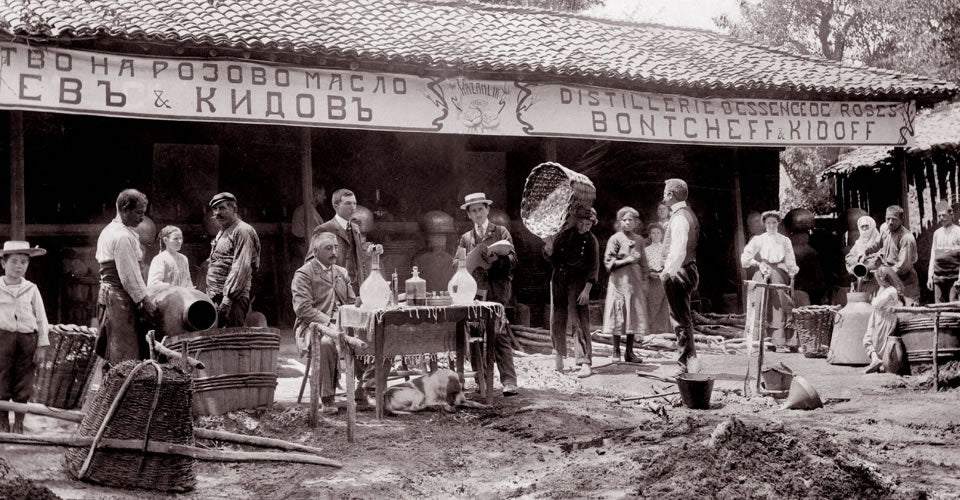
The Kazanlak Valley. Damascena roses picked before dawn, when oil concentration peaks.
Gentle & Rose is not a corporation. It is a family. I want to be precise about what I mean by that, because I have been lied to by enough "family" brands over the years that I no longer take the word at face value. I asked for the company registry documents. I asked for the production address. I asked for video calls from inside the workshop. I cross-checked everything against the Bulgarian commercial register, which is publicly searchable in English.
Everything matched. The family has been connected to the rose oil trade in the valley for three generations. They grew up watching tanker trucks arrive during harvest season to buy oil in bulk — oil that would be shipped to France, diluted to trace concentrations, poured into beautiful bottles, and sold back to European women at fifty, a hundred, sometimes two hundred times the cost of the raw material.
I asked them, on a video call from their workshop, why they had started Gentle & Rose. The window behind them showed rose fields stretching toward the mountains.
"We watched this happen our entire lives. The best rose oil in the world leaves Bulgaria at €6,000 to €8,000 per litre. It arrives in Paris. And then a luxury brand puts 0.3% of it into a serum, wraps it in a forty-euro box, hires a celebrity, and sells it for €300. The woman who buys it thinks she's buying Bulgarian rose oil. She is buying a memory of it. We grew up watching this, and at some point my mother said: what if we stopped watching, and made it ourselves, and shipped it directly to her?"
That is the entire business. No celebrity ambassador. No department store contract. No glossy campaign. They formulate in small batches in their workshop. They source the rose oil directly from cooperative farms in the valley — the same ones that supply the luxury houses, except they use it at therapeutic concentrations instead of decorative ones. Every batch is manufactured under EU Cosmetics Regulation EC 1223/2009 — the same regulatory framework that governs cosmetics sold across the European Union and the United Kingdom. Same standards as Dior. Different priorities entirely.
That last part is important. Because when I asked them what the product cost, I thought there had been a translation error.
What's Actually Inside the Bottle
The product is called Rose Youth Elixir.

I spread Dr. Ferrand's printout on the hotel bed and went through it with the Rose Youth Elixir ingredient list beside me. What I found made me angry. Not at this brand. At every brand that had sent me a £200 bottle over the past decade with a press release about "revolutionary concentrations".
Three actives. No filler. Here's what Ferrand had circled, and what she'd written in the margins in small blue biro.
Bakuchiol, at 2%. This one she'd underlined three times. In the margin, in capitals: "THIS IS THE CLINICAL DOSE. EVERYTHING ELSE AT 0.3% IS A MOISTURISER WITH A MARKETING CLAIM."
Bakuchiol is a plant compound that works through the same biological pathway as retinol — stimulating collagen, accelerating cell turnover, reducing fine line depth — without the irritation and sun sensitivity that make retinol intolerable for many women over 40. At the 0.2–0.5% levels found in most luxury serums, it functions as a mild antioxidant. Essentially decorative. At 2%, it crosses the clinical threshold Ferrand had spent an hour explaining to me — directly stimulating the genes responsible for collagen production while inhibiting the enzymes (MMP-1, MMP-3) that break collagen down as we age.
Bulgarian rose oil, cold-pressed damascena grade, from the Kazanlak Valley. Ferrand had drawn an arrow to the word damascena and written, in the margin: "the same grade Grasse buys at €6,000 a litre to dilute into perfume. This bottle is using it at therapeutic concentration. For British skin — fighting damp cold and central heating every day — this is the barrier repair nothing in a luxury serum provides."
Low-molecular-weight hyaluronic acid. The margin note on this one was shorter. Just: "not the surface HA — the real one. This one actually reaches the dermal layer. Hydration that holds 12–16 hours, not 60 minutes."
Three ingredients. Clinical concentrations. No filler cocktail of thirty compounds designed to make the label look impressive. I closed the printout and sat on the edge of the hotel bed for a minute, and I thought about every woman I'd ever met at a beauty counter being walked through an ingredient list by a sales assistant who was reading it off a laminated card.
I had been so focused on the chemistry that I had almost forgotten to ask about the price. By the time I went back to the brand's website that evening in my hotel room, I had already mentally prepared myself. Clinical-grade bakuchiol at 2%. Real damascena rose oil. Low-molecular HA. I was expecting £100. Maybe £130. At the concentrations Dr. Ferrand had walked me through, even £180 would have made sense against what I had been reviewing for years.
I switched the site to the UK version. I scrolled to the product page. And I actually said it out loud, alone in my hotel room:
"That can't be right."
£34. (€39 at the Paris-facing checkout — same formula, same bottle)
I checked it twice. I went back to the certificate of analysis. I emailed the family that night and asked them, directly: how is this possible? The answer was the simplest sentence I had heard in twelve years of writing about consumer goods.
"Because we don't spend money on anything except what goes inside the bottle. No celebrity. No campaign. No department store. No distributor taking 40%. The formula is the product. The price is the cost of the formula."
£34. Less than a blow-dry. Less than a decent lunch. Less than the last serum sitting half-used on your bathroom shelf that you already know is not doing what it promised.
Ships to the UK. All duties and VAT included. 5–9 business days to your door.

The Women Who Told Me What It Did
Three of the women I interviewed have given me permission to tell their stories the way they told them to me. I have changed nothing.
I met Isabelle on a Friday morning at a café near her firm. She arrived in a navy blazer, no makeup except lipstick, and spoke with the kind of precision you would expect from a woman who argues tax law in front of senior judges for a living. She is not, in any sense of the word, a woman who exaggerates.
She told me she had spent over €2,200 on serums the previous year. She knew the number because she had looked it up the night before our meeting, half-embarrassed and half-furious. La Mer. Sisley. Augustinus Bader. None of it was working.
One morning last March, she had applied her foundation and watched it settle into the lines around her mouth in a way it had not done six months earlier. She stood at her bathroom mirror, and for the first time in years, she just stopped and looked.
That afternoon, her 14-year-old daughter glanced up from her phone over lunch and said — casually, the way teenagers say things that cut to bone:
"Maman, why do you always look so sad?"
Isabelle did not cry when she told me this. But she stopped talking for a moment. Then she said: "I was not sad. I was angry. Because I had done everything right and it was not enough."
She ordered the Elixir in April. By week three, a colleague stopped her in the corridor and said, "Isabelle, you look rested. Did you take time off?" She had not. She had been working eleven-hour days preparing for a case. By week five, her daughter frowned across the breakfast table: "Maman, your skin looks better than mine. How?"
Isabelle looked at me across the café table and said, very quietly: "The wrinkles did not vanish. I am 51. Some of those lines are earned. But my face looked alive again. Like something that had been asleep had woken up."
If you're recognising yourself in any of this — here's what Isabelle ordered →
I flew back to London at the end of that week. Somewhere over the Channel, I opened my laptop, went to the brand's UK site, and bought a bottle on my own credit card.
I told myself I bought it as part of the investigation.
What I had not expected was how quickly I would start hearing the same stories in English.
Sarah is not the type to order skincare from a country she has never visited based on a Facebook post. She told me that twice during our conversation, as if she still could not quite believe she had done it.
"I'd been using the same Clinique routine since my 30s. Added a Lancôme serum because the woman at the John Lewis counter was lovely and very persuasive. Between the two of them I was spending about £150 every couple of months. And my skin was fine. Fine, but not... better. You know that feeling? Where everything is perfectly adequate but nothing is actually changing?"
She saw a post about the Elixir in a skincare group on Facebook. Spent an evening reading the comments. Looked up bakuchiol. Compared concentrations. Went down a research rabbit hole that lasted until midnight. "The price nearly put me off, but for the opposite reason you'd think. It seemed too cheap to be serious. I spend more than that on a blow-dry."
She ordered one bottle. It arrived in just over a week. "The first two weeks, I noticed my skin felt different under my fingers when I washed my face at night. Smoother. Not just on the surface — like the texture itself had shifted."
Week three, she was on a Teams call with the other Year 6 teachers and one of them interrupted the meeting: "Sarah, what have you done? Your skin looks unreal."
"I rang my sister that night and told her to order it. She is now on her second bottle."

"The price nearly put me off — for the opposite reason you would think."
Helen is practical. She does not read beauty magazines. She does not follow skincare influencers. The only reason she tried the Elixir was that her daughter had sent her a link with a single line of text: "Mum, just look at the ingredients."
"I've never been someone who spends big on skincare. A bit of Olay, maybe something from Boots if it was on offer. But the last couple of years, I started noticing things. The lines around my mouth getting deeper. The way my makeup looked by lunchtime — like it was sliding off. I'd catch myself in the rearview mirror after dropping the grandchildren off at school and I'd think, when did that happen?"
Three weeks in, Helen was at Sunday lunch at her daughter's house in Morningside. Her grandchildren at the table — eight, five, and two. Her daughter pulled out her phone. "Mum, smile."
Helen told me what went through her mind in the half-second before the shutter. She could hear herself thinking it, she said, the same loop she'd been running for two years whenever a camera came out in a room:
Not this angle. Not this lighting. Ask her to take it again. Ask her to delete it if it's bad. Tell her to do it from the side. Not this one. Not this one.
And then, she said, she just... didn't. She looked at the camera. Her daughter took the photo.
A minute later, the phone came round the table. Helen looked at the screen.
"I didn't look younger, Eleanor. I want to be clear about that. I'm fifty-three and I look fifty-three. But I looked like me. Not the version I'd been flinching away from for two years. Just — me. And I didn't ask her to delete it."
Her son-in-law, across the table, saw her face and said, "You alright, Helen?"
She told me she didn't cry. But her daughter put the phone down and came round the table and hugged her.
Her husband — a man who, she said, would notice a new car on the drive about three days after she'd parked it there — said to her that evening, while they were watching telly: "There's something different about you. I can't put my finger on it."
"That is probably the most romantic thing he has said since 2006," she told me. And we both laughed until she had tears in her eyes.
What Actually Happens — Week By Week
Every woman I interviewed described the same progression. Here is what to realistically expect, in the language Dr. Ferrand used when I asked her.
If you want to see whether week three happens to you — it ships in 5–9 days →
The Questions I Asked, So You Don't Have To
Because I came into this as a hostile reporter, I asked every question a hostile reader would ask. Here are the four that matter.
"£34 seems too cheap to be serious." £34 is what skincare costs when a family makes it themselves and ships it directly. No brand tax. No celebrity campaign. No department store shelf space. No advertising budget eating sixty percent of the retail price before the formula is paid for. The ingredients are the same grade used by luxury houses. The concentrations are higher.
"Is it safe? It is from Bulgaria." Gentle & Rose manufactures under EU Cosmetics Regulation EC 1223/2009, the same regulatory framework that governs cosmetics sold across the European Union and the United Kingdom. Every batch is independently safety-assessed. Bulgaria is not a shortcut. It is where the roses grow — and where 85% of the world's rose oil is produced.
"What if it does not work for my skin?" Bakuchiol is one of the most well-tolerated active compounds in modern dermatology. Unlike retinol, it does not cause irritation, peeling, or sun sensitivity. Dr. Ferrand prescribes it specifically for sensitive skin and rosacea-prone skin. If for any reason it does not work for you, there is a full 30-day money-back guarantee. No questions asked.
"What if it breaks me out?" The formula contains three active ingredients and no comedogenic fillers. No silicones, no synthetic fragrance, no pore-clogging emollients. It is one of the cleanest formulations I have reviewed in fourteen years.
EC 1223/2009
Markets Served
Guarantee
All Duties Included
If those were the four questions you were asking — it's here →
Why You Are Reading This Here, and Not in a Magazine
I filed the piece six weeks after my editor commissioned it. I included Dr. Ferrand's comparison table, Isabelle's story, the family video call, the certificate of analysis, and a closing paragraph that said something to the effect of: I went to find a scandal and I came back with a serum I have been using for six weeks and I cannot, in good conscience, write the takedown I was hired to write, because the takedown would not be true.
My editor read it overnight. She rang me the next morning. The conversation was short.
"Eleanor. This is not what we commissioned."
"I know it's not. But it's what I found."
"This reads like an advertorial."
"It reads like an advertorial because the truth in this case happens to be flattering to a small Bulgarian company. That doesn't make it untrue. It makes it inconvenient."
There was a long pause on the line. Then she said the sentence I had half been expecting since I had first opened the new draft in my Paris hotel room.
"I can't run this. We have three luxury beauty advertisers in this issue alone. I'm sorry. Pitch me something else."
I did not pitch her something else. I asked for the piece back, kept the kill fee, and put the draft in a folder on my desktop labelled Pieces I am proud of and cannot publish. It is not the first piece in that folder. It is the first one I have not been able to let go of.
Three weeks later, I emailed the family in Bulgaria and told them what had happened. I asked if they would be interested in hosting the piece, in full, on their own website. I offered three conditions: nothing would be edited, I would retain copyright, and they would pay me the same fee my original publication would have paid me — and not a penny more. No bonus for traffic. No incentive for sales. No commercial relationship beyond the one-off licence fee for hosting an existing piece of journalism.
The family agreed to all three conditions within the same day. The version on this page is identical, word for word, to the version that was killed.
Why It Sells Out
The Rose Youth Elixir is not in pharmacies. Not in department stores. Not on Boots or Lookfantastic or Cult Beauty. There are no influencer deals. The reason comes back to the rose oil itself — and to the fact that this is a small family operation, not a factory.
The damascena harvest in the Kazanlak Valley happens once a year. Three weeks in late May and early June. When the harvest is over, the raw material for the year is set. There is no synthetic alternative that matches the bioactive profile. When the oil runs out, production for the year is capped.
Current capacity is approximately 500 bottles per month. When they are gone, they are gone until the next batch is produced. This is not a marketing countdown. It is agriculture.
I confirmed directly with the family at the time of writing: fewer than 40 bottles remain from the current allocation.
Two Mornings
In one version, you close this page. You go back to the bathroom shelf. You squeeze out another drop from the bottle you already half-suspect is not delivering what it promised. The lines keep settling. The foundation keeps creasing. You keep tilting the phone and telling yourself it is the lighting. You keep spending another hundred pounds, another two hundred pounds every few months, because the beauty industry taught you that if it didn't work, you just hadn't spent enough yet.
In the other version, you try a formula built around concentration instead of branding. Made by a family in a rose valley who put the money inside the bottle instead of on a billboard. You give it three weeks. You watch for the small things first. How your skin feels when you wash your face at night. How your makeup sits differently on Wednesday than it did on Monday.
And sometime around week three, someone says something. "There's something different about you."
And for the first time in a long time, when you look in the mirror, you agree with them.
£34.
Less than a blow-dry. Less than a decent lunch. Less than the last serum sitting half-used on your shelf.

Ships directly from the family workshop to anywhere in the UK.
All duties and VAT included. Arrives in 5–9 business days.
The Week-Three Guarantee
If you don't have a moment in week three where someone notices — anything about your skin, your face, how rested you look — you can return it for a full refund. No forms. Just email the family and say "week three didn't happen." They'll refund the order, shipping included.
"I rang my sister that night and told her to order it. That's the review. When a product is good, you ring your sister."
— Sarah, Bristol
Order Rose Youth Elixir — £34 While Stock Lasts
Ships within 48 hours · Limited to current production cycle
Eleanor Whitfield is a consumer affairs journalist based in London. This piece was originally commissioned for a UK national publication in 2025 and is republished here under licence with full editorial independence.