INVESTIGATION
Something Strange Is Happening in French Beauty Groups — and American Women Are Starting to Notice
I covered beauty for thirty-one years. Two months after I retired, a friend in Paris sent me a screenshot at eleven at night. I got on a plane. This is what I found, and why it took me until now to write it down.

The screenshot

I almost didn't open it.
It was May 2019. I had been retired for exactly nine weeks. Thirty-one years as a beauty editor, from 1988 until that March, across three magazines, the last of them for nineteen years — and for the first time since the Reagan administration, nobody was waiting for me to have an opinion about anything.
So when Hélène, a publicist in Paris I have known since my second year in the business, sent me a screenshot at 11pm on a Tuesday, I nearly left it for morning. I no longer had a morning to leave it for. That was rather the point of retiring.
Her message said: "You need to look at this. I have never seen anything like it."
I should tell you who is saying this, briefly, because it matters for what comes later.
Four hundred launches, at a conservative estimate. Laboratories in France, Switzerland, Japan and Korea. I learned to read an ingredient list in about four seconds and know whether the front of the box was true, and I learned which contract manufacturers make which brands — there are serums on the same counter, at three prices, that come out of the same building. I never bought a product. Not one, in thirty-one years. They arrived free, in beautiful boxes, with handwritten notes.
So I know what a beauty thread looks like when it is about to burn itself out. This was not that.
The group
The group was called "Les Secrets de Beauté Parisiens." Over fifteen thousand women. Invitation only. Mostly professionals in their forties and fifties — lawyers, architects, university lecturers. Not women who lose their heads over a skincare launch.
The screenshot showed a single thread. Over six hundred comments. Women tagging friends. Sharing delivery tracking numbers. One woman had posted four separate updates in seventy-two hours, each more emphatic than the last.
The product they were losing their minds over was not Dior. Not La Mer. Not anything you would find at Sephora or behind the counter at a Paris pharmacy.
It was a small white bottle from Bulgaria, made by a family I had never heard of. And it cost less than most of them spend on a weekday lunch.
The comments read like nothing I had seen in three decades:
"I'm 48, I work full-time, I don't have time for ten-step routines, and this is the only product that has made a visible difference in five years."
"My husband asked what I'd done to my face. He never notices anything. ANYTHING."
A no-name serum from Eastern Europe, generating more excitement among sophisticated Parisian women than products that cost ten, fifteen, twenty times more.
Something did not add up.
And in thirty-one years I had learned that when something does not add up in this industry, there is usually a story underneath it. I had also learned, the hard way, that the story is usually the opposite of what the thread thinks it is.
I bought a ticket to Paris. I want that on the record: I bought it. After thirty-one years of being flown places, this was the first trip I ever paid for myself, and I paid for it because I intended to find out what was wrong with this bottle.
What I found in Paris

The morning I landed I emailed the group's moderator — a marketing director named Valérie — and asked whether any of the women would speak to me.
Within forty-eight hours, forty of them had replied.
I was not expecting that. These women were not looking for publicity. They wanted somebody to explain it to them. They were as confused by the product working as I was by the product existing.
I spent a week meeting them. A café near the Marais, where a fifty-one-year-old tax attorney took the bottle out of her handbag and set it down between our espressos like a piece of evidence. A restaurant near Odéon, where three friends who had started using it weeks apart kept finishing each other's sentences.
Every woman I spoke to had spent years — and thousands of euros — on premium skincare. Beautiful packaging. Ingredient lists like a chemistry lecture. Serums that felt lovely going on and did nothing underneath.
And every one of them described the same slow, quiet realization:
"It wasn't working. None of it was working."
Not dramatically. Not overnight. The kind of failure you do not notice until one morning your foundation settles into lines that were not there six months ago. Or somebody says something casual that follows you for weeks. Or you catch yourself tilting your phone in every photograph, because the front camera has become something you negotiate with.
I sat in that café and I recognized every word of it. Not as a journalist. I will come to that.
Does any of this sound familiar?

Before I tell you what I found out about why, see whether any of this is you.
— Your foundation settles into lines it did not catch a year ago
— Your face feels tight within minutes of washing it, and you have started to assume that is simply what a face feels like now
— Your skin has gone papery — not lined, papery — on the cheeks, the neck and the backs of your hands
— Products that suited you for twenty years began stinging somewhere around fifty-five
— You have spent $100 or more on a serum that did not do what it promised
— Somebody has said you look tired on a day you felt perfectly fine
— You tilt your phone, or adjust the angle, before anyone takes a photograph
— You have quietly stopped expecting any product to make a difference, and buy them out of habit
If you checked even one of those, the women in that Paris group felt exactly what you are feeling. Every one of them. And what I learned next is why.
I am going to give you the reasoning before the bottle, because the reasoning is what I was paid to do for thirty-one years and never quite did. But if you would rather skip to the product, you can jump to it here.
What nobody in the beauty industry will say out loud

Before flying home I made one more stop. Lyon.
Her name is Odile Marchand, and for thirty-four years she formulated with plant actives for the houses — Grasse first, then Paris, senior enough in the last eleven to sign things off. In 2016 she left, went home to Lyon and opened a herbalist's shop in the old town, the kind with drawers to the ceiling and a brass scale on the counter. Her customers are mostly professional women, forty to sixty-five. Women who invest seriously in their skin and have started to wonder why.
We sat in the back of the shop on a gray Tuesday afternoon, and I asked her a simple question: why do expensive serums stop working?
She said something I have not been able to stop thinking about since.
"They don't stop working, Carol. Most of them never started. Not at the level the campaign promised."
Then she explained the thing every formulator knows and no marketing department will ever put on a poster.
The active in most anti-aging serums — retinol, bakuchiol, the peptides, vitamin C — only does anything above a specific concentration. Below that line the ingredient is on the label, it is in the campaign, it is the first thing the associate mentions at the counter. And it is doing nothing at the level of the skin where aging actually happens.
I asked her to put it in terms I could understand.
"Think of it as a prescription. You go to your doctor with an infection. She knows you need five hundred milligrams to clear it. But she writes you thirty — one-sixteenth of the dose — because the pharmacy wanted the rest of the budget for the packaging. You take it every day. You feel like you are doing something sensible. The infection does not clear, because thirty milligrams was never going to touch it. That is the industry. The active is there at a dose that is right for the label and useless for the biology."
So what is the real dose?
"For most of the actives worth having, you are looking at one to two percent before anything measurable happens. Under one percent you are in the decorative range. Most of what I formulated for the houses sat at nought point two to nought point five. Four to ten times below the line."
And where does the three hundred dollars go, if not into the bottle?
"The box. The campaign. The face of the campaign. The counter — the counter on its own can be a third of the retail price. By the time all of that is paid for, what is left for the formula is a sliver, and the sliver decides the dose. The woman at home puts it on every night and feels she is doing something, and she is. She is moisturizing. She could do that with a four-dollar tub. The difference bought her a feeling, not a function."
A feeling. Not a function.
Think about that the next time you are standing at the Sephora counter being told this season's serum is the one — or adding a $180 moisturizer to your Nordstrom cart at midnight because the reviews sounded convincing.
The women in that Paris group had not found a miracle. They had found a product where the money went into the formula instead of everything around it.
And then I told her about my own face
Here is the part I had not said out loud to anyone in the business.
At fifty-five, my skin did not gradually change. It fell off a cliff, in the space of about eighteen months, and nothing in twenty-three years of writing about aging skin had prepared me for the speed of it. It was not lines. I had lines at forty and I had made my arrangements with them. It was that the whole surface changed character — thinner, drier, duller, slacker, and unable to hold on to anything I put on it.
I was recommending serums to women of sixty-five, in print, while mine did that.
So in my last working years I did the thing I should have done in my first: I read the trials. The papers, not the summaries. And I started writing down the ages of the women on the test panels.
They stop.
Not officially. Not by any policy anywhere. But they stop. The panels cluster in the thirties and forties, thin out through the early fifties, and by the time you reach women of my age there is very little there at all. The products I had recommended to women of sixty-five had, in the main, been tested on women of forty-two.
Odile was not remotely surprised.
"Post-menopausal skin is a different substrate. Less collagen, almost no sebum, a damaged barrier, slower renewal, less blood supply. If you formulate for a woman of forty and sell it to a woman of sixty-five, you are not treating the same organ. And nobody funds the trials, because the panels cost the same and the market is smaller. It is not wickedness. It is a spreadsheet."
I asked her, finally, what she would tell a woman of sixty-one to look for. She thought about it for a long moment.
"Three things. An active at a real concentration, not a decorative one. Something that rebuilds the lipid barrier, because yours has gone and nothing else will work until it is back. And it has to come from somebody with no counter to pay for and nobody famous on the payroll — because if they are paying for those, there is nothing left to put in the bottle. Find that and you will have something. It will not be in a department store."
I wrote those three things on the back of an envelope. Then I looked at the small white bottle the tax attorney had set down between our espressos, and I did something I had not done in thirty-one years of being flown to laboratories.
I went to see where it came from.
So I kept going. To Bulgaria.
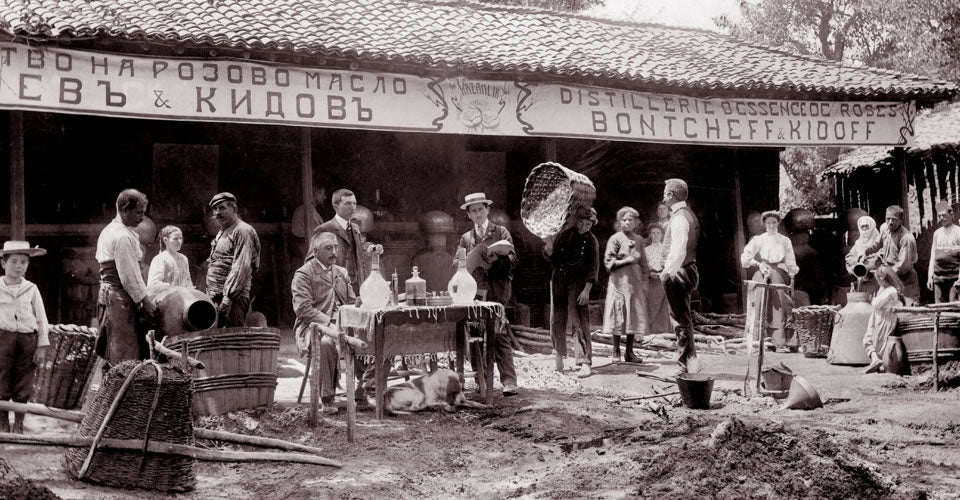
Here is something I did not know before that week, after a career spent writing admiringly about rose oil.
Bulgaria produces roughly 85 percent of the world's supply of it. Not rose water. Not synthetic rose fragrance. The real thing — cold-pressed damascena rose oil, the same grade bought by the perfumery houses in Grasse.
The center of it is the Kazanlak Valley, between two mountain ranges in the middle of the country. Warm days, cool nights, loamy soil — a microclimate that produces roses with an oil concentration nobody has managed to replicate anywhere else. The harvest lasts about three weeks in late May and early June. The flowers have to be picked before dawn, because that is when the oil content peaks and it falls away as the sun comes up. It takes roughly 3,500 kilograms of petals to produce one liter of oil, which is why that liter leaves the valley at six to eight thousand euros — call it $6,500 to $8,500.
I arrived on the twenty-eighth of May. The harvest was three days from ending. I stood in a field at half past four in the morning with a hundred women in headscarves and I watched the thing I had written about for three decades actually happen.

Gentle & Rose is not a corporation. It is a family.
I met them at their workshop — and I use the word deliberately, because it is not a factory. It is a small production space in a town near the valley where the family has lived for three generations. Through the window behind them the rose fields ran toward the mountains.
They grew up watching the tanker trucks arrive every harvest to buy oil in bulk — oil that would go to France, be diluted to a trace, poured into beautiful bottles and sold to women in Paris and New York at fifty, a hundred, sometimes two hundred times the cost of the raw material.
"We watched this happen every year. The best rose oil in the world leaves Bulgaria at six to eight thousand euros a liter. It arrives in Paris. And then a luxury brand puts nought point three percent of it in a serum, wraps it in a forty-euro box, hires a celebrity and sells it for three hundred. The woman who buys it thinks she is getting Bulgarian rose oil. She is getting a memory of it. Enough to print on the label and nothing more."
The question that started the company was the simplest thing I heard all year: what if we skipped all of that? Made it ourselves, at real concentrations, and shipped it directly to the woman?
No celebrity. No department store. No distributor. No advertising budget eating sixty or seventy percent of the price before a single drop of active is paid for. They formulate in small batches, source the oil directly from the cooperative farms in the valley — the same farms that supply the perfumery houses — and manufacture under EU cosmetics regulation, which requires an independent safety assessment of every product before it can be sold. The FDA does not require that for skincare sold in the United States.
I had Odile's envelope in my bag. Real concentration. Barrier repair. Nobody famous, no counter. I stood in that workshop and checked all three.
What I have been using since that summer

It is called Rose Youth Elixir. It costs thirty-nine euros — about forty-two dollars, depending on the day — and I have used it morning and night since June 2019.
I will take you through it the way I would have in a review, except that this time nobody is paying for the pages.
First condition: an active at a real concentration
The active is bakuchiol, at two percent.
Bakuchiol is a plant-derived compound that behaves in the skin much as retinol does — accelerating cell renewal at the surface and stimulating collagen and elastin underneath — without the irritation, peeling, sun sensitivity or adaptation period that makes retinol close to unusable for a great many women my age.
The number is the point. Most of what I was sent over thirty-one years contains bakuchiol at nought point two to nought point five percent, exactly as Odile described. Decorative. Two percent is above the line at which anything measurable begins.
It is, in her language, the five hundred milligrams rather than the thirty.
Second condition: something that rebuilds the barrier
Cold-pressed damascena rose oil from the valley I had just stood in, at a concentration nobody carrying a department store could afford to use.
This matters more after menopause than anything else on the label, and it is the part I understood last. When oil production stops, the lipid barrier that holds water in your skin and keeps irritants out degrades — and until that barrier is rebuilt, nothing else you apply will hold. You can put the finest active in the world on a face that cannot retain moisture and watch it do very little.
Rose oil carries several hundred bioactive compounds that calm inflammation and rebuild that lipid layer. Alongside it there is low-molecular hyaluronic acid, which holds water in the deeper tissue rather than on the surface for an hour — and if your skin spends its days between office air conditioning and forced-air heat, that is the difference between moisture that is gone by mid-morning and hydration that lasts.
And the one I did not expect
Lactic acid. The quietest thing on the label and, at my age, the one I was most pleased to find.
It gently loosens the bonds holding dead cells at the surface so they shed rather than accumulate — which is precisely the problem when renewal has slowed to a crawl. It works on the same layer as the bakuchiol, from the other side. It also carries pigmented cells away with it, which is why the mottling on my cheekbones and the backs of my hands is less obvious than it was, though that has been slow.
Third condition: nobody famous, no counter
There is no celebrity. There is no department store. There is no distributor. It is not at Sephora, it is not at Nordstrom, and it is not in a drugstore.
Four active ingredients at real concentrations. No filler cocktail of thirty compounds designed to make the label look impressive. The people who make it had a simpler idea than anybody I ever wrote about: skip everything in between, formulate for the biology, and mail it to the woman.
And for what it is worth, since nobody ever tells you what a serum feels like: the texture is light, almost watery. It absorbs in seconds. A faint rose scent — the real thing, like a garden at dawn — gone within a minute. No residue, no waiting around before makeup. Two drops, morning and night. That is the routine.
See Rose Youth Elixir — €39, about $42 →
Ships to the US. No tariffs, no duties, no hidden fees. 5–9 business days.
The numbers on it
I would draw your attention to the first figure rather than the second, and I say that as somebody who spent three decades watching brands lead with the wrong number. Wrinkle depth is what sells. Skin roughness is what actually changes how a face looks in a room, because a rough surface scatters light and a smooth one returns it — and after menopause, roughness is the thing that arrives first and most visibly.
Then American women started ordering

The Elixir was never marketed in the United States. No ads, no stockists, no PR. It spread the way things spread now — a sister who had been to Paris brought a bottle home in her suitcase, an expat in Lyon posted about it, her college roommate in Connecticut ordered one that night.
By the time I got home from Bulgaria I was already hearing from American women in the group. I asked them to write to me. Margaret was the first to write back.
Margaret T., 58 — Columbus, Ohio: "Three retinols made my face peel like a sunburn. This didn't sting once, and at week eight my daughter asked what I'd had done. Nothing, honey. Two drops a day."
Here are three more:
Diane R., 61 — Scottsdale, Arizona: "I've spent $300 on serums that did less than this $43 bottle. The dark spot on my left cheek — the one I've had since 2019 — is honestly half as visible. I ordered two more before they sold out again."

Susan K., 52 — Raleigh, North Carolina: "The smell alone told me this was different. Real rose, like a garden at dawn, gone in a minute. My foundation stopped creasing by the second week. I've repurchased twice."

Patricia M., 64 — Sarasota, Florida: "At my age I don't expect miracles, I expect honesty. Twelve weeks in, my neck and jaw look firmer in photos and my skin isn't tight by evening for the first time in years. It took six days to arrive. Worth every one."
Four women. Not a clinical trial and I would never dress it up as one. But it is four women between fifty-two and sixty-four, in four states, with the same quiet arc — and after thirty-one years of reading panels that stop at forty-two, that was the thing I had been waiting for somebody to show me.
And what happened to me

I started the day I got home from Bulgaria, and I photographed myself every Monday morning for twelve weeks in the same bathroom light, which was not an enjoyable exercise.
The first two weeks — comfort, and nothing else
My face stopped feeling tight. That is all, and I nearly dismissed it, because a moisturizer will do that and I have been sold that sensation four hundred times.
I mention it because for a woman past menopause it is not nothing. Comfort is the barrier coming back, and until the barrier comes back nothing else can. But if you buy this and judge it at two weeks, you will conclude what I nearly concluded, and you will be wrong.
Weeks three to six — the surface
The change was in texture rather than in lines. My skin stopped feeling papery to the touch and started reflecting light instead of absorbing it — which is the difference between looking tired and looking well, and it is far more of what we are actually reacting to in the mirror than any of us admit.
Makeup sat differently. I use very little now, but what I use stopped settling into things.
Week nine — my sister
My sister Ruth is two years younger than me and has never once been tactful about anything in six decades.
She came for lunch that August, looked at me across the table before she had her coat off, and said: "All right. What did you do? You look good."
Which, from Ruth, is a standing ovation.
For the record, and because I have spent this entire article complaining about people who do not do this: I was sixty-one then and I looked sixty-one. I am sixty-eight now and I look it. My lines are where they were. My jaw has not come back and nothing on this earth is going to bring it back short of a surgeon.
What changed is that my skin behaves like skin again. Seven years on, it still does. That turned out to be the thing I actually wanted.
What it costs, and how many to buy

Thirty-nine euros. About forty-two dollars, give or take, depending on the day.
I have been pricing serums for thirty-one years and I have products in this apartment, sent to me free, that cost eight times that and contain a quarter of the active. When I first saw the figure on the website, in a hotel room in Paris, I said out loud to nobody: that can't be right. Then I assumed something was wrong with the formula, which is why I went to Bulgaria.
It costs what it costs because there is no counter, no celebrity, no distributor and no advertising department. That is the entire explanation. It is the same explanation, running the other way, as the three-hundred-dollar one.
And one honest word about quantity
A bottle is thirty milliliters, which is four weeks of using it properly, morning and night.
I am going to be straight with you about what that means, because it is what I would want a friend to tell me. Four weeks gets you the comfort and the beginning of the surface change. It does not get you the rest. The measurable work is done at eight and twelve weeks, and you cannot reach twelve weeks on four weeks of product.
Buying one bottle is buying the first chapter. That is a perfectly reasonable thing to do. But do it knowing that is what you are doing.
▸ One bottle — €39, about $42
Four weeks. Enough to find out whether it agrees with you.
▸ Two bottles — €35.10 each, about $38, with shipping included
Eight weeks. Through the point where the structural change is measured. Shipping is free over €50, about $54, which one bottle does not reach.
▸ Three bottles — €33.15 each, about $36, shipping included, plus a bottle of organic rose water
Twelve weeks, which is the full length of the work the numbers are based on. This is what I buy.
See Rose Youth Elixir — €39, about $42 →
What twelve weeks might look like

Imagine washing your face at night and it not feeling tight afterwards. That is the first one, and it is smaller and more important than it sounds.
Imagine putting a hand to your own cheek and finding that it does not feel like paper.
Imagine standing under the overhead light in a store or a hospital corridor or your own kitchen and not doing the small internal flinch you have been doing for years.
Imagine getting a photograph back from Thanksgiving and being able to look at it properly, at full size, without going straight to your own face.
And imagine somebody who has known you for forty years looking at you across a table and asking, with no reason at all to ask, what you have been doing to yourself.
Not looking younger. I am sixty-eight and I look it. Looking well, which is a different thing, and the thing I had actually lost.
What to realistically expect

Between the women who wrote to me, my own weekly photographs and the brand's own published timeline, the pattern is consistent enough that I will put my name to it.
Weeks 1–2 — comfort, and nothing you would photograph
Tightness after washing goes. Flaking settles. This is the barrier repairing and it is the least interesting part of what is coming. It is also the week almost everybody nearly gives up.
Weeks 3–6 — the surface changes
Papery texture softens. Skin starts reflecting light rather than absorbing it. Makeup sits differently. This is where the roughness figure comes from, and for a post-menopausal face it is the change that alters how you look in a room.
Week 8 — the structural one
Firmness and density. This is the point the measurements are taken at, and the point one bottle will not get you to.
Week 12 — the full length of the work
Lines softened, tone more even, mottling less obvious. Twelve weeks is three bottles, and there is no way around that arithmetic.
Every woman who wrote to me said a version of the same sentence: I nearly stopped at the beginning, and I am very glad I did not.
The things you are reasonably thinking
"Thirty-nine euros cannot be any good." — I spent a week in Bulgaria on this exact objection, because I have been trained by the same industry you have to read price as proof. But the price is not a statement about the formula. It is a statement about the absence of a counter, a celebrity and a distributor. Same grade of rose oil the perfumery houses buy. Four to ten times the concentration of active.
"Is it safe? It's from Bulgaria." — Every batch is manufactured under EU cosmetics regulation, which requires an independent safety assessment before a product can legally be sold in Europe. The FDA does not require that for skincare sold in the United States. Your Sephora shelf is less regulated than this family's workshop. And Bulgaria is not a shortcut — it is where 85 percent of the world's rose oil comes from. The same farms that supply the perfumery houses supply this family. The difference is what happens to the oil after it leaves the valley.
"My skin has become reactive since menopause." — This is the most common thing I hear from women my age and it is the single best argument for bakuchiol over retinol. No irritation, no peeling, no sun sensitivity, no adaptation period. Patch test first, as you would with anything, but this is the class of active designed for exactly this problem.
"Is it not too late for me?" — I started at sixty-one, six years past menopause, and it was not too late for me. Patricia is sixty-four. What is true is that you cannot rebuild what has gone. What you can do is repair a barrier, restore renewal at the surface, and stop the loss accelerating. That is worth having at any age and it is worth having most at ours.
"What about shipping to the US?" — It ships from inside the EU. No tariffs, no duties, no hidden fees — the price you see is the price you pay. 5–9 business days. Shipping is free over €50, about $54.
"Do I still need sunscreen?" — Yes, and more than you did at forty. Antioxidants help defend against environmental damage; they are not a sunscreen. If you care about the mottling in particular, daily SPF is the difference between fading it and making more of it.
See Rose Youth Elixir — choose one, two or three bottles →
Sixty days, which is longer than it needs

There is a sixty-day money-back guarantee on it, counted from the day it arrives, and I want to do the arithmetic with you rather than simply wave at it, because after thirty-one years I have some feeling for what a guarantee is actually saying.
Sixty days is eight and a half weeks. The point at which the structural change is measured is week eight. Day fifty-six.
The guarantee outlasts the milestone by four days.
That is not a generous returns policy. That is a company saying: take it the whole way to the thing we told you about, and if it has not happened, we will pay for the experiment ourselves.
I have sat in four hundred launches and I have never once seen a large brand offer that, and I would ask you to think about why. You cannot bring a half-used serum back to a beauty counter in week eight and say it did not work. You are expected to conclude that you used it wrongly, or too late, or that you are simply the age you are — and then to buy something else.
So the downside is straightforward. You are out nothing. No forms, no questions. The only thing you can lose is another eight weeks of the arrangement you already have.
Try it for sixty days, counted from the day it arrives →
Two mornings

In one version, you close this page. You go back to the shelf. You squeeze out another drop from the bottle you already know is not delivering what it promised. The foundation keeps creasing. You keep tilting the phone and telling yourself it is the lighting. You keep adding another $100, $200 to the cart every few months, because the industry I worked in for thirty-one years taught you that if it did not work, you just have not spent enough yet.
In the other version, you try a formula built around concentration instead of a campaign. Made by a family in a rose valley who put the money inside the bottle instead of on a billboard.
You give it twelve weeks. You watch for the small things first. How your skin feels when you wash your face at night. How your makeup sits differently by Wednesday than it did on Monday.
And somewhere around week eight, somebody says something. Something small. Across a kitchen table, with no reason at all to say it.
"All right. What did you do? You look good."
And for the first time in a long time, when you look in the mirror, you agree with them.
What I would do, if you were one of the women who wrote to me
Buy three. Not because it is the larger order, but because a bottle is four weeks and the work is measured over twelve, and every woman who wrote to me was still changing at week eight. Three is €33.15 each — about $36 — with shipping included and the rose water in the box.
I spent thirty-one years telling women what to buy, and I was wrong more often than I was right, and I was wrong in a very particular way: not by lying, but by never asking the question a French herbalist answered for me in the back of her shop in an afternoon.
This is the first thing I have written that no advertising director has seen and no brand has approved. I am sixty-eight. My lines are where they were. But my face stopped feeling like paper seven summers ago, and it has not started again.
"They don't stop working, Carol. Most of them never started." — Odile Marchand, Lyon, May 2019